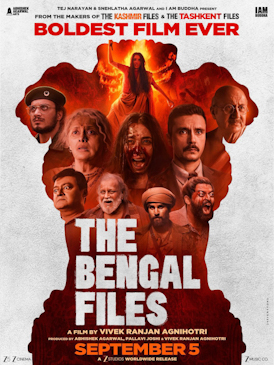

The Bengal Files is a 2025 Indian Hindi-language political drama propaganda film written and directed by Vivek Agnihotri. It presents a storyline focused on the Direct Action Day and the Noakhali riots, depicting the violence and its aftermath as a genocide. The film stars Mithun Chakraborty, Pallavi Joshi, Darshan Kumar, Anupam Kher and Simrat Kaur.
The Bengal Files is the third and final installment in Agnihotri's The Files Trilogy based on modern Indian history, following The Tashkent Files (2019) and The Kashmir Files (2022). With a runtime of 204 minutes, it is one of the longest Indian films and was released on 5 September 2025. The film received criticism over its distortion of history, and was commercially unsuccessful.
Plot
The story begins in present-day India with a senior Central Bureau of Investigation officer, Shiv Pandit being assigned to trace a missing journalist, Gita Mukherjee who had been working on sensitive historical research. Geeta had been investigating old records from Bengal around 1946 before disappearing under suspicious circumstances. At first, Pandit treats it as a routine missing-person case, but he quickly finds that multiple official files related to the journalist's work have been sealed, altered, or completely erased. People who were last in contact with Gita either refuse to speak or provide contradictory accounts, and it becomes clear that powerful interests are actively obstructing the investigation.
As Pandit follows the journalist's trail, he discovers that the missing research focused on events in Bengal during 1946, especially the communal violence that erupted around Direct Action Day in Calcutta and later spread to other regions. The narrative shifts repeatedly into flashbacks showing how rising political tensions between communities, fueled by colonial withdrawal and competing political demands, escalated into large-scale riots, killings, and mass displacement. These events are shown through multiple perspectives, including survivors, victims, and those caught in political machinery, revealing confusion, fear, and breakdown of authority during that period. Pandit learns that many of the testimonies recorded at that time were either suppressed or never officially documented, creating gaps in historical records.
Back in the present, the investigation intensifies as Pandit uncovers that Gita had identified a hidden pattern linking certain families, political figures, and institutions to both the 1946 events and present-day influence networks. Each breakthrough leads to increased pressure on Pandit, including surveillance, intimidation, and attempts to shut down the case. A key turning point occurs when he finds an old survivor, Bharti Banerjee who directly connects the missing Gita's final research notes to a specific chain of events during the riots in Noakhali and Calcutta, suggesting that some incidents were systematically documented and then deliberately erased.
As Pandit reconstructs the timeline, it reveals how decisions made during the 1946 unrest, including targeted violence, forced migrations, and political negotiations, created long-term consequences that were later buried in official narratives. Gita's investigation is shown to have uncovered inconsistencies in these historical records, particularly regarding responsibility and the scale of violence in certain regions. In the final act, Pandit manages to recover Gita's complete findings, which expose the full extent of the suppressed information and the deliberate distortion of historical documentation. The climax centers on the confrontation between the recovered truth and the forces attempting to keep it hidden, culminating in the exposure of how past violence and present-day power structures are connected through systematic erasure of evidence, and ending with the resolution of the missing case through the revelation of what truly happened to the Gita.
Cast
- Mithun Chakraborty as Mad man Chatur
- Pallavi Joshi as Maa Bharati / aged Bharti Banerjee
- Simrat Kaur as young Bharati Banerjee
- Darshan Kumar as Shiva Aloke Pandit, Special Investigating Officer, CBI
- Anupam Kher as Mahatma Gandhi
- Saswata Chatterjee as Sardar Husseini, MLA, Murshidabad
- Eklavya Sood as Amarjeet Arora "Amar"
- Namashi Chakraborty as Gholam Sarwar Husseini
- Rajesh Khera as Muhammad Ali Jinnah
- Puneet Issar as Rajnath Singh, Director, CBI
- Priyanshu Chatterjee as Justice Banerjee
- Dibyendu Bhattacharya as Rajendra Lal Roychowdhary
- Sourav Das as Gopal Patha
- Mohan Kapur as Suhrawardy
- Digvijay Purohit as Jawaharlal Nehru
- Jivraj Pipaliya as Sardar Patel
- Vinayak Miskin as Liaquat Ali Khan
- Richard Keep as Lord Mountbatten
- Emily R. Ackland as Edwina Mountbatten
- Raj Kanani as Sheikh Mujibur Rahman
- Anubha Arora as Gauri
- Dibanisha Banerjee as Gita Mandal
- Rumi Jaffery as Agha Jameel Kashmiri
- Madalsa Sharma as Sardar Husseini's wife
- Ruma Mandal as Bharati's mother
- Diksha Raina as Shiva's mother
Production
Agnihotri announced the project in April 2022 following the success of The Kashmir Files. He initially titled the film The Delhi Files: The Bengal Chapter to emphasise his belief that "the destiny of India is written in Delhi and not in Bengal". In June 2025, Agnihotri officially renamed the film to The Bengal Files: Right to Life, reflecting the central focus on Bengal history rather than Delhi.
Agnihotri explained that the title shift was prompted by public sentiment: a social media poll received overwhelming support for renaming the film to better reflect its subject. He said, "The first and foremost reason is that the film is about Bengal... then I did a poll where 99 people asked me to change the title. That's when I thought, why get stuck in the communication... Now, it makes more sense." He also noted that the second part of the project will similarly undergo a title change after the first chapter's release.
Principal photography began in November 2024. Agnihotri confirmed that filming was wrapped by the end of January 2025.
Pallavi Joshi had initially refused to play her role, feeling it was too big a responsibility, and even suggested Agnihotri, her husband, to cast another actress of the character's age. She eventually decided to play the character after much persuasion.
Soundtrack
The soundtrack of The Bengal Files consists of a single released song and a background score.
The devotional folk-based song Kichudin Mone Mone was released as the first single. It is sung and composed by Parvathy Baul, with lyrics credited as traditional.
According to the film's credits, Samarth Srinivasan is listed under the music department.
Theatrical
The Bengal Files was theatrically released on 5 September 2025. The film received an A (adults only) certificate from the CBFC, with a runtime of 204 minutes, with reasons citing extreme violence and gory content. Agnihotri warned that he will pursue legal action if West Bengal prevents the release of his film. Actor Victor Banerjee urged the President of India to guarantee that the screening occurs peacefully, free from intimidation or interference, and that the rights of both artists and audiences are fully safeguarded. Prior to the film's release, Agnihotri publicly appealed to West Bengal Chief Minister Mamata Banerjee, urging her not to impose a ban on the film. He emphasized that it was a work of art and historical storytelling, rather than a means of division.
Accusations of non-release in West Bengal
A day before the film's release, Pallavi Joshi alleged that the film had been unofficially banned in West Bengal, claiming theatre owners were being intimidated due to political pressure. She wrote a letter to Droupadi Murmu, the President of India, urging protection of the film's supposed constitutional right to be viewed. This issue escalated further when Amit Malviya, the chief of BJP IT Cell, accused the Mamata Banerjee-led Trinamool Congress government of unofficially banning the film, while the accused party denied any involvement in the film's non-release, asserting that the decision rested solely with theatre owners and multiplex operators. Theatre owners in Kolkata clarified that no slots were available for the film as they were already screening films such as The Conjuring: Last Rites, Dhumketu, Bohurupi, and Baaghi 4.
Amid the controversy, it was announced that the film will eventually have its first invitation-only screening in Kolkata on September 13, 2025, at Dr. Syama Prasad Mookerjee Bhasha Bhavan, which is part of the National Library. The screening was organised by the socio-cultural platform Khola Hawa, restricting entry to the venue. A massive contingent of the Central Industrial Security Force (CISF) was deployed inside the National Library, and the audience included BJP leaders, former Meghalaya Governor Tathagata Roy, and noted Bengali singer Paroma. Swapan Dasgupta, a member of the BJP national executive and former MP, stated that Union Home Minister Amit Shah took a personal interest in arranging security and hoped that after the screening, theater owners would feel encouraged to show the film.
On 23 September 2025, the Calcutta High Court eventually questioned the West Bengal government whether it had imposed any restrictions on the film's release in the state. The state government told the Court that there was no such official or unofficial ban on the film.
Box office
As of 25 September 2025, The Bengal Files has grossed ₹13.99 crore (US$1.5 million) in India, with a further ₹2.2 crore (US$230,000) overseas, for a worldwide total of ₹16.19 crore (US$1.7 million).
Critical response
The Bengal Files received predominantly negative reviews from critics. On the review aggregator website Rotten Tomatoes, four of six critic reviews are negative.
Mukund Setlur, writing for Deccan Herald, called the film a "double-edged disaster" and a "dilemma emerging from incoherent writing and poor editing". Kartik Bhardwaj of Cinema Express gave the film 1 star out of 5, claiming that it reeked of propaganda and made for an excruciating experience akin to a bland history lesson, where even the performances could not leave a mark and felt perfunctory. Anuj Kumar from The Hindu reviewed the film negatively as well, accusing it of using cinema as a tool to divide, and also added that "the makers create their own history around the recorded events". Radhika Sharma of NDTV found the film unending, disturbingly graphic, gory, and gruesome, while also finding the imagery "in your face" and the performances screechy and over the top.
Abhishek Srivastava from The Times of India gave the film 3.5 stars out of 5, noting that it reveled in shock value, and with scenes of grotesque violence succeeding in evoking anger, despair and reflection, the film also managed to connect at an emotional level, "offering glimpses into suffering that transcended politics". Anurag Singh Bohra from India Today gave the film 3 stars out of 5, praising the performances and visuals, while also feeling the execution was marred by slow pacing, nonlinear storytelling, and a stretched runtime. Rishabh Suri from Hindustan Times gave the film 3 stars out of 5, feeling that while the film did get over-indulgent at times in its treatment of history, it was salvaged by "fine performances". Rachit Gupta from Filmfare gave the film 2.5 stars out of 5, labelling it "a violent and over-dramatised look at partition horrors".
Lachmi Deb Roy from Firstpost gave the film 2 stars out of 5, praising the performances except that of Darshan Kumar, and finding the story gripping while also feeling the characters were not comprehensively written and that the execution could have been better. Titas Chowdhury from CNN-News18 also gave the film 2 stars out of 5, finding the lengthy runtime to be its biggest weakness, the violence nauseating, and the film as a whole underwhelming even as a piece of art. Shubhra Gupta from The Indian Express gave the film 1.5 stars out of 5, finding the performances overwrought, the violence sickening, and the overall execution loose and confused. Shomini Sen from WION felt that while the story was compelling, the execution was problematic, and the film was too graphic and divisive to be taken seriously. Shilajit Mitra of The Hollywood Reporter India praised the set extensions and the framing in a couple of countryside scenes, but felt the film made no room for depicting the plight of the Muslims killed in the partition riots and the only solution it offered was answering communalism with communalism. Anant Gupta of Scroll.in says, "Other than gore, the film has nothing perceptive to say about communal violence. It leaps from one scene to another without offering a diagnosis or even a coherent critique of the passions that drive people to commit horrific acts of violence on one another". Gupta further highlights the use of narratives, slogans, and symbols aligned with Hindutva, a Hindu nationalist ideology.